
What VINELink Covers in Tehama County
VINE is a custody-status and notification service. That is its whole job. Tehama County's District Attorney Victim-Witness page lists VINELink. It sits beside the county jail, the California inmate locator, ICE notification, and local police resources. Sheriff policy also asks victim-assistance material to cover VINE availability and registration, so the county treats it as an official pathway. A link is not a guarantee, though. It does not prove every booking appears or set an update interval, so confirm Tehama in the current California selector before searching. VINELink never creates the arrest report, booking photo, filed charge, or final judgment, and the county arrest guide shows where those separate records live.
How to Check a Tehama County Arrest on VINELink
- Open the official VINELink California page.
- Select California and the Tehama County or statewide county path offered by the live interface.
- Enter the name and, when accepted and known, an offender or booking identifier.
- Review every match and compare spelling, identifiers, facility or agency, and status.
- Open the correct result and compare it with the Sheriff roster when county custody is expected.
A name alone proves nothing. Two people in Tehama County can share one. Search with every identifier you have, then compare any match against the official jail roster. A blank result can mean the booking has not reached VINE yet, the agency is offline, the person was released, or custody sits in another system.
What VINELink Shows After an Arrest
Fields vary by agency. A Tehama match shows custody status only. It is not a criminal history. Read it as a quick in-custody check.
| Possible field | Use and limitation |
|---|---|
| Name | Starting identity field; compare it with identifiers. |
| Offender or booking ID | A stronger matching key when supplied. |
| Custody status | The connected system’s status, which may lag a jail event. |
| Facility or agency | The reporting custodian, not necessarily the arresting agency. |
| Status event | May support release, transfer, escape, or other notices. |
| Notification option | Registration control after selecting the correct person. |
VINELink does not verify booking photographs. Photos live elsewhere. The sheriff's records unit holds the booking photo. Disposition belongs to the Tehama Superior Court.
How to Register for Custody Alerts
Registration starts from a person-specific result. Do not register from a guess. California county VINE instructions outline phone and email pathways, a PIN you create, and notices for release, transfer, escape, or other changes. Options vary, so follow the live form.
- Confirm the person and agency before selecting registration.
- Choose an offered method such as phone or email.
- Enter accurate contact details and create the requested PIN.
- Complete confirmation and save the PIN securely.
- Keep contact information current and follow instructions when an alert arrives.
An alert is a prompt, not a safety plan. Treat it that way. When a release affects immediate safety, contact a victim advocate or law enforcement right away. Never approach someone because an alert arrived.
VINELink Limits and How to Confirm
The Sheriff roster is a custody table. It stamps a generated timestamp. VINE runs on its own clock, so a fresh booking can reach the jail and the service at different times. Compare the booking number, date, agency, charge, bail, release field, and any linked detail. Check both before calling. If an urgent question remains, call the jail at (530) 529-7910. Records requests go to (530) 529-7940 or records@tehamaso.org. The Arrested Today guide gives the same-day sequence.
Why Tehama Victim Services Links VINE
The District Attorney Victim-Witness resources place VINE among separate custody and support channels.
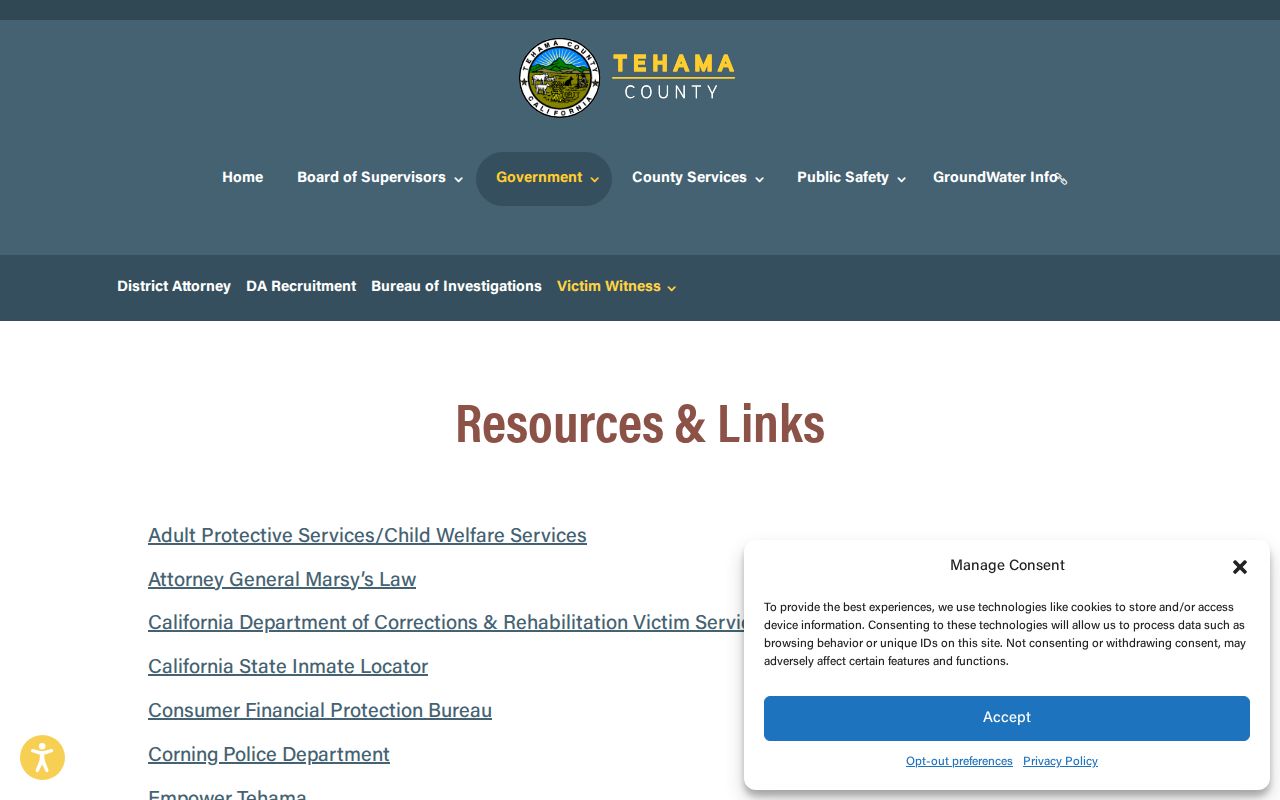
Victim services link VINE for a plain reason. It is the county's referral path for custody checks and release alerts. That link is not a feed contract. Sheriff policy backs the tool when available, so keep the jail's phone path alongside any alert registration.
Recognizing California VINELink
The official California VINE entry is the documented statewide starting point.
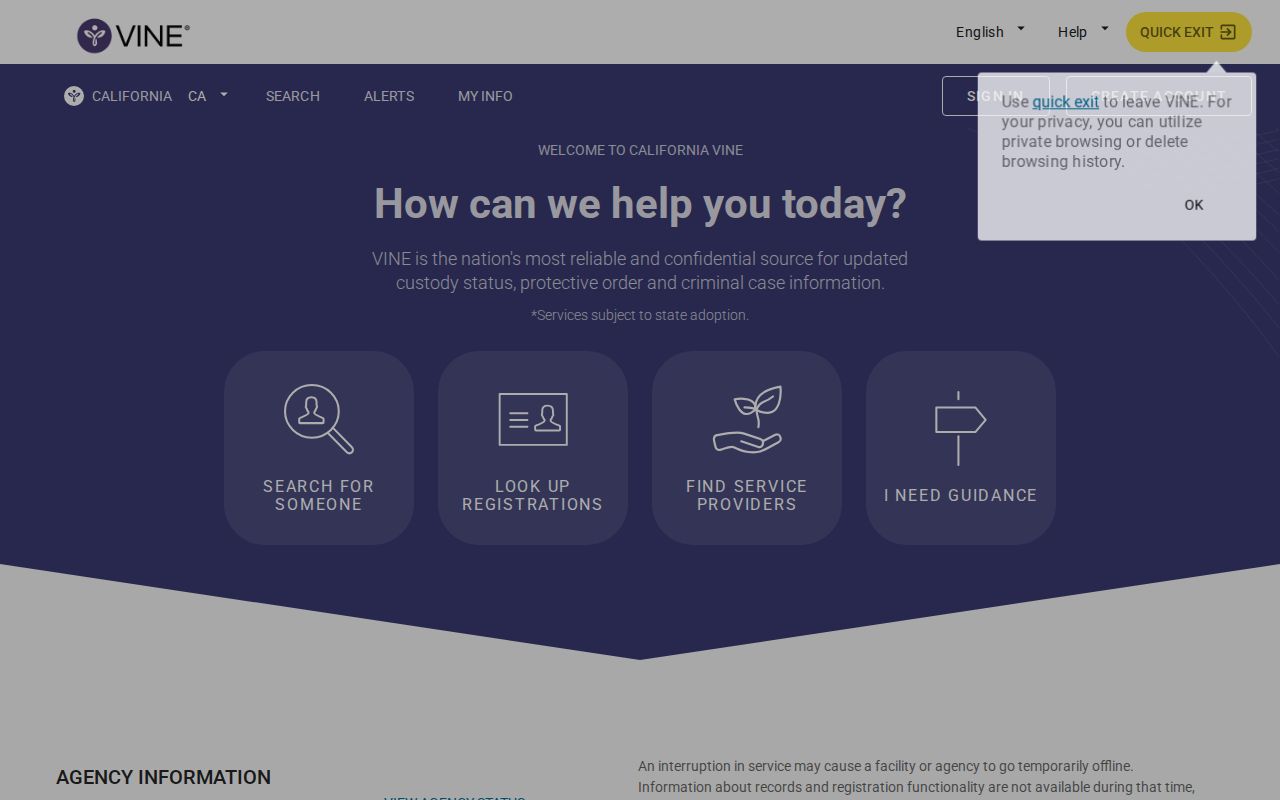
This is the official California VINELink service, not a people-search page. Commercial sites often copy its look. Use the live interface itself. Its controls can change.
Custody Systems VINELink Does Not Replace
VINELink fills one niche. It is not a full arrest history, court docket, warrant search, or mugshot source. Federal custody needs the Bureau of Prisons locator. Immigration detention runs through ICE's own system. State prison? That belongs to the California Department of Corrections and Rehabilitation. County custody starts with the Sheriff. Disposition sits with the Tehama Superior Court. After a booking, a person can move among systems through release, transport, a state sentence, a federal matter, or a hold, so a "not found" in one place means nothing everywhere else.
Understanding Release and Transfer Alerts
A release alert reports one custody event, nothing more. People leave the Tehama County Jail for many reasons. Bail, release on recognizance, a completed county sentence, a court order, or another documented cause can all open the door. The roster's scheduled release field is no promise. Holds and processing can shift the timing. Transfer alerts need the same context. Sheriff Jail Services material describes extraditions, court and medical movements, prison transport, and returns of people arrested elsewhere on Tehama matters. A new facility does not change the arrest record itself. Find out which agency now reports custody, and keep the offender or booking identifier so the search continues in the right system. When an alert lands, write down the date, time, agency, and event wording. Then check the linked record. If accuracy matters immediately, call the responsible office. Delivery can fail too. Contact settings, service interruptions, and outdated information all play a part. Registration builds awareness, yet it cannot promise every development arrives in time.
Safer VINE Registration Practices
Register with contact details the intended recipient actually controls. Keep the PIN private. Save it apart from any public notes. Don't share a result screen that displays personal contact details. If a phone number or email address changes, update the registration through the current interface instead of assuming notices will follow on their own.
VINE serves victims, family members, attorneys, and others with a genuine custody-notification need. Don't use it to harass, track, or confront anyone. An alert connected to a protective order or an immediate safety concern calls for an established safety plan, so contact the appropriate advocate or agency promptly.
Tehama County runs a separate service called Tehama Alert. It pushes emergency, missing-person, evacuation, road-closure, and wanted or dangerous-person messages through Everbridge. A photo may be attached. There is no inmate lookup, and no person-specific jail release registration. Choosing the correct system keeps an emergency broadcast signup from being mistaken for custody monitoring.
Use VINE Arrest Alerts Responsibly
Use VINE for legitimate notification and safety needs. A status line is operational information. It shows where a person stands in custody at that moment, nothing more.
Before acting on an alert, confirm details with the agency that booked the person. A quick call settles most questions. Registration is one step, not a whole safety plan. Note: keep contact information and the registration PIN current, but do not depend on one automated notice for immediate personal safety.
What to Do After a Custody Alert
Read the event type, reporting agency, and time before drawing any conclusion. "Released" marks a custody change alone. It does not end a case or supervision. "Transferred" can mean another jail, a court, medical care, state prison, or another responsible agency. The Sheriff's Jail Services material documents court and medical transports, extraditions, prison movements, and returns of people arrested elsewhere on Tehama matters.
Use the identifier saved at registration to check whichever system now holds the person. If county release is the issue and accuracy matters, call the jail. State custody points to CDCR, federal custody to BOP. Check ICE only where immigration detention is truly at issue. Never infer a destination from the original arrest charge.
An alert is one piece of a safety plan. The Tehama District Attorney Victim-Witness program routes support needs. Emergency danger belongs with 911. VINE registration never replaces protective-order instructions, direct agency contact, or advice from counsel.
Resolve Multiple VINELink Name Matches
Start with spelling variants and any known middle name. Don't pick a record on a familiar name alone. Compare identifiers instead. Check the reported facility, agency, and status too. Age or descriptive details help only when the interface supplies them, and they should never override a conflicting identifier.
The Sheriff's linked detail record can supply a booking number, file number, book date, arresting agency, physical description, charge, bail, and possible photograph. Use those official fields to settle the ambiguity. No booking photos are republished here.
If two plausible matches remain, call the responsible custodian instead of guessing. A wrong-person notification causes needless alarm and misuse of personal information. Write down the date and source of any confirmation, since custody status can change after the check.